
David J. Byron
Principal, Chief Executive Officer

The 2025 KPMG M&A and Economics Forum offered a clear message for anyone leading their business through these uncertain times: chaos is the new norm, and handling disruption must be a constant strategy. Every conversation, from economists to CEOs to futurists, pointed to the same truth, the future is fluid and being re-created in real time. Those who are willing to adapt with fluidity and have a gameplan for constant change will thrive, and those that are still looking for linear roadmaps will die.
That theme resonates deeply with me and something we’ve been advising our partners on with increasing urgency over the last five years.
Multiple presenters noted that we’re now a half decade into the turmoil that began with the pandemic, and it has continued to roll forward with a constant state of turbulence unlike any other time in modern history. Like riding a ship through a storm, and the only way to stay healthy is to keep your eyes on the horizon. But what horizon is that? It’s unique for each organization, each team, and the waves are not traditional peaks and valleys, they’re completely erratic coming from all directions.
The discussions at the Forum reinforced many of the forces shaping our world, and why our role at SundbergFerar, and our value to our partners, is to interpret complexity and establish a clear vision through intelligent learning, the development of a strategic innovation gameplan, and the implementation of tactical tools to design product and experience solutions for the future, daily.

As we look ahead to 2026, the following themes are a synthesis from multiple perspectives presented and interpreted through our design and innovation lens as we work to create meaningful solutions across numerous categories.
1. The Age of Regenerative Resilience
Disruption demands regenerative resilience — the ability to continually rebuild while moving forward. Futurist Elatia Abate described a “stackable factory” of knowledge work where teams modularize capabilities to stay agile. She warned though that “bad strategy can lead you to a rolling ball of bad decisions.”
This mirrors what we call Design Harmony at Sundberg-Ferar: balancing clarity of self, team, and organization with left brain, right brain thinking. Companies that can “do and undo” constantly creating and iterating at speed, will outlast those trapped in static plans focused on just being more efficient with incremental improvements.
SF Takeaway: The companies thriving in the next decade will design adaptability into their DNA, and make a nimble Strategy Blueprint their new gameplan, not a roadmap, as linear models are a thing of the past.
2. Predictable Behavior Is A New Global Currency
Predictability itself is becoming a competitive advantage. This does not mean predictable product roadmaps, earnings forecasts or acquisitions plans, but simply the predictability of an organization’s behavior, an organization’s leadership, and the humanity of an organization that knows who it is and how it interacts with the ecosystem around it. That is immeasurable as a new market value driver. Do others know who you are and trust you? Supply chains, partnerships, and growth strategies all depend on trusted eco-system and this driving your value equation.
Economist Brent Neiman reminded the audience that most global trade today happens through ingredients, not finished goods — proof of how deeply interwoven modern economies have become. This complexity puts more value on private and public sector relationships where more progress, and money, is made in arenas where the players know and trust each other.
SF Takeaway: Design for interdependence, not isolation. Products and experiences aren’t created inside closed walls, they’re designed in networks of trust. In a world of fragmentation, confidence, creativity and credibility are as valuable as capital.
3. Market Psychology and the Fear of Standing Still
One economist observed that chaos creates three things: more chaos, destruction, or creates new (optimism) and always produces positives and negatives, both winners and losers. If you’re stuck in a fear mindset and do nothing, you will be one of the losers.
In design and innovation, that fear shows up as hesitation. Yet history rewards those who act decisively in uncertain markets. The leaders who see volatility as opportunity and not paralysis will be the ones shaping new categories while others wait.
SF Takeaway: Emotion drives markets as much, if not more than, metrics. Successful leaders blend intuition with insight to navigate both. One driver to help leaders make the decision to innovate is to identify and quantify a future where the worst outcome is one where nothing is done.
4. The AI Divide: Risk-Averse vs. Opportunity-Driven
Ted Shelton’s discussion on AI revealed an interesting cultural split amongst eastern and western societies that mirrors research we’ve done in HMI cognitive loads: only 30 percent of U.S. professionals trust AI/big-tech compared to 70 percent globally. Katrina Mulligan, Head of National Security Partnerships at OpenAI also noted that instead of taking a proactive approach to secure enterprise engagement, too many US corporations are operating with fear and hesitancy, thinking that avoiding AI is the most secure option, all while their employees are casually using free AI accounts to get their work done. They both urged leaders to identify three to five workflows where AI can amplify human talent — and to move enterprise adoption from curiosity to commitment and capability.
At Sundberg-Ferar, we see this daily. The organizations moving ahead aren’t the ones chasing AI for headlines — they’re the ones working with us to integrate it securely into how they learn, decide, design, and deliver.
SF Takeaway: The real AI advantage lies not in experimentation, but in adoption — where human creativity meets machine intelligence with purpose. We’re helping teams take that step with human enhanced AI techniques used in the right places for the right reasons to research and design new products and services.
5. Growth Without Jobs and the Inequality Gap
KPMG’s Chief Economist, Diane Swonk, painted a sobering picture of economic growth without jobs. We’re in a time of dissonance and growing inequality. She referred to Shakespeare’s line “all that glistens is not gold” from the Merchant of Venice to articulate what we’re seeing in the numbers is covering many flaws under the surface. 80 percent of Americans have fallen behind inflation, and we look eerily similar to 1998 before the dotcom bust.
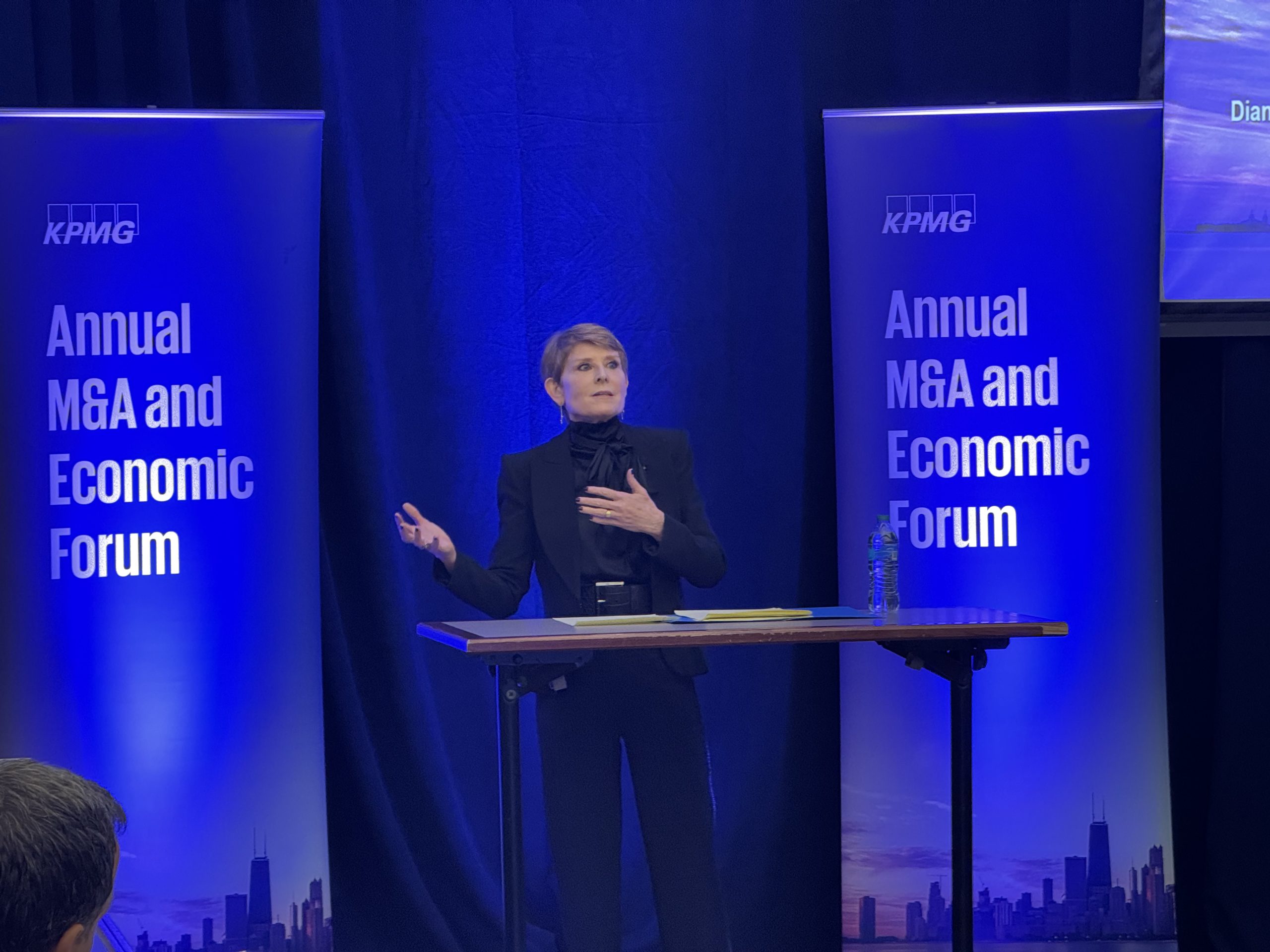
Her analysis echoed the work by Nobel Prize winners Joel Mokyr, Philippe Aghion and Peter Howitt, that innovation’s impact depends on its adoption rate. The gap between invention and useful inclusion is widening. Leaders can’t measure success only in content and delivered outcomes; they must also consider the humans that convert those outcomes into something satisfyingly consumable.
SF Takeaway: Sustainable growth demands designing for people, the talented creators, the providers, the caregivers, the communities and the consumers.
6. Durability Over Agility
AON CEO Greg Case made one of the most practical statements of the day: “You have to be durable because the game will keep changing.” He prefaced Elatia Abate’s closing theme of regenerative resilience, while he brought a sharp focus on designing a strategy for durability, which is not to say it’s in conflict with speed; it’s what makes speed sustainable.
One theme he and many others touched on as the driver for success is the ability to acquire, retain, and grow talent. To remain durable in a time of volatility, you must have talent and they have to buy into your culture, vision and beliefs. Greg offered four key areas corporations must address to become durable: trade, tech, climate, and workforce.
SF Takeaway: Agility wins the sprint; durability wins the marathon. The future belongs to teams that can do both. Throughout our 90+ years of designing durable hard goods, we’ve learned that the people and innovation process have to be durable as well to survive and thrive that long.
How Sundberg-Ferar Can Help You
At SF, we help organizations learn faster, decide smarter, design stronger and deliver real results. Our team translates human centered behavior, product expertise, service design and new technologies into actionable design strategies. Whether helping a mobility brand rethink access systems and design their next product family, or guiding a wellness solution provider through AI adoption to improve their user experience, our mission remains constant: turn uncertainty into confidence and bring ideas from the blue-sky to ground-level.
We design not only what products and services do, but who organizations become — resilient, human-centered, and ready to translate volatility into opportunity for a future constantly being created.
From Chaos to Clarity
Author
David J. Byron
Principal, Chief Executive Officer
As Principal and Chief Executive Officer, David leads the firm and our partners to design with purpose and create new futures. With over 12 years at SF, and 25 years in the industry, David’s passion for learning and ability to translate complex problems into simplified opportunities with clear pathways to tactical solutions has helped SF’s partners bring game-changing solutions to market.
More thoughts from David
Bio
Discover more articles on Innovation Strategy


Want to get started?
We’re ready when you are…
Get innovative design insights right to your inbox
Want to get started?
We’re ready when you are…
Get innovative design insights right to your inbox